
In grief there is sadness and there is longing.
And also the quiet, unsettling thought:
Something is wrong with me.
You forget things mid-sentence.
You walk into a room and lose your train of thought.
You feel disoriented in places that used to feel familiar.
At times, you even expect the person who died to walk through the door.
This experience is often misunderstood.
It can be labelled as denial, emotional instability, or an inability to cope.
But what is happening is far more precise than that.
It is neurological.
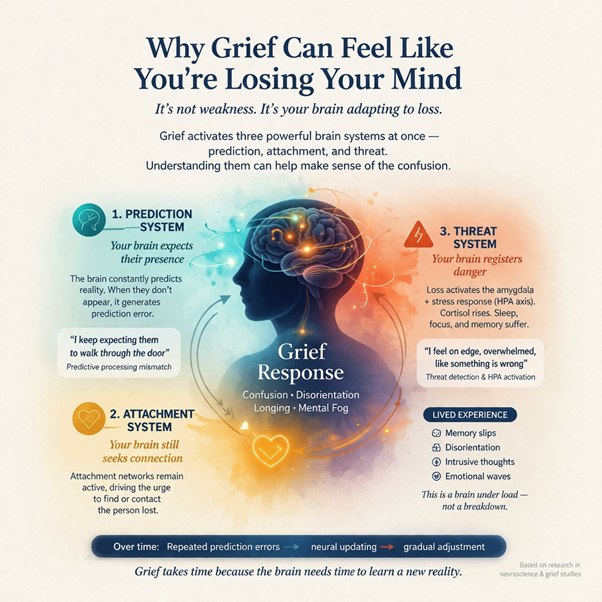
Grief activates several core systems in the brain at the same time.
Among them, three play a central role: prediction, attachment, and threat.
The brain struggles to update reality
The brain is not a passive observer of the world. Quite the opposite, the brain’s job is to constantly predict the world around us.
In neuroscience, this is often referred to as predictive processing.
The brain builds internal models based on repetition, allowing it to anticipate what will happen next and reduce uncertainty.
The people we love become part of these models.
They are not simply remembered.
They are an expected part of our reality.
You expect their presence in the same way you expect the ground to be beneath your feet.
When someone dies, this internal model does not immediately change and adjust.
The brain continues to predict their presence.
You reach for your phone to message them.
You expect to hear their voice in the next room.
For a brief moment, it can feel as though nothing has changed.
This mismatch between expectation and reality is known as prediction error.
And in grief, it does not just happen once.
It happens repeatedly.
Each time, the brain is forced to adjust.
This process is slow and painful.
It requires energy.
And it can leave you feeling mentally exhausted and disoriented.
The attachment system continues to search
At the same time, the attachment system remains active.
From a neurobiological perspective, attachment is not only emotional.
It is a survival mechanism.
It is supported by networks in the brain that drive proximity, connection, and the regulation of safety.
When the person is alive, this system helps stabilise your internal world.
Their presence becomes part of how your nervous system feels safe.
When they die, the system does not immediately shut down.
It continues to search.
This is why grief can feel restless, repetitive, and at times irrational.
A part of the brain is still trying to locate the person who is no longer there. It is the persistence of a system that was designed to keep you connected.
The nervous system registers grief as a threat
Alongside prediction and attachment, the brain also processes loss as a disruption to safety.
Grief is not only experienced as absence. It is experienced as instability.
Research has shown increased activation in regions such as the amygdala and anterior cingulate cortex in people who are grieving, alongside elevated stress responses through the hypothalamic-pituitary-adrenal (HPA) axis.
In practical terms, this can mean:
Sleep becomes fragmented.
Attention becomes narrower.
The body feels tense, alert, or depleted.
Cortisol levels can remain elevated, keeping the nervous system in a prolonged state of stress.
The body is not simply sad.
It is responding as if something fundamental has shifted in its sense of safety.
Living in two realities at once
When these systems are active together, the experience can feel deeply confusing.
One part of you understands that the person has died.
Another part still expects them to exist.
This is why grief can feel like living in two realities at once.
It is also why it can affect memory, attention, and perception in ways that feel unfamiliar.
The experience is not imagined.
It reflects the brain attempting to reconcile two conflicting pieces of information:
They were here.
They are no longer here.
A process that takes time
Over time, the brain begins to adjust.
Not through a single moment of understanding, but through repeated exposure to a reality it did not predict and did not choose.
Gradually, the internal model changes.
The prediction errors become less frequent.
The attachment system softens its search.
This is not linear.
And it is not something that can be rushed.
Grief takes time because the brain requires time to update.
Not as a concept, but as a biological process of recalibration
A different way of understanding
For many people, understanding this changes the experience.
It does not remove the pain.
But it can remove the additional layer of fear that something is going wrong.
What feels like losing your mind is often your system doing exactly what it is designed to do:
Trying to make sense of a world that no longer matches the one it knew.
And doing so, slowly, in its own time.
This is the foundation of my course Your Brain and Your Body on Grief, where I guide you through these processes in more depth, so you can understand what is happening inside you and feel more steady within it.