
Grief doesn’t only break your heart.
It changes how your brain functions.
Many people describe it the same way:
A constant fog.
Words just out of reach.
Walking into a room and forgetting why.
Reading the same sentence three times and nothing stays.
By now, you may already understand that grief affects attention (see last week’s post)
and creates confusion about reality (the week before last).
This is different.
This is brain fog.
And it has very little to do with weakness or lack of effort or lack of willpower.
In the early stages of grief, people often notice confusion and disorientation. The mind continues to expect the presence of the person who died. This is what we explored in the first two articles: the brain as a prediction system, and the way attachment keeps someone present in our internal model of the world even after they are gone.
Brain fog is different.
It is less about confusion, and more about capacity.
When someone you love dies, your nervous system shifts.
Even if your life looks stable on the outside, internally your system is working continuously. It is processing emotional pain, adjusting to absence, and trying to maintain some form of equilibrium. This ongoing activity is not always visible, but it is metabolically demanding.
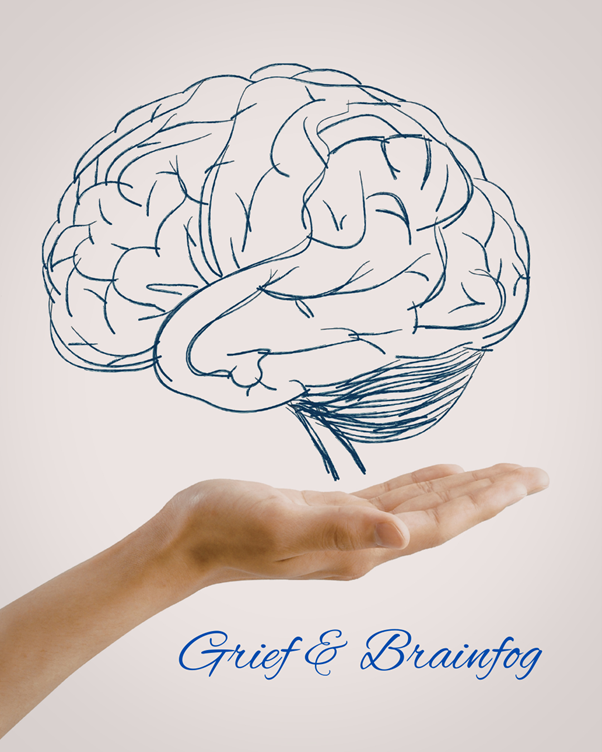
At the same time, the brain is engaged in a complex process of memory reorganisation.
The person who died is not stored in a single place in the brain. They exist across networks of memory: shared routines, familiar places, sensory cues, future plans. The brain now has to update all of these associations.
The chair they used to sit in.
The message you would have sent.
The plans you had for next year.
Each of these requires revision.
Neuroscientist Mary-Frances O’Connor describes grief as a process of learning. The brain is gradually adapting to a new reality in which the person is no longer physically present. This adaptation does not happen all at once. It unfolds over time, through repeated encounters with absence.
This creates load.
And when the brain is under load, it reallocates its resources.
Functions such as attention, working memory, and verbal recall are not prioritised. The system shifts towards emotional processing and regulation. From an evolutionary perspective, this makes sense. When something significant changes in our environment, the brain focuses on integrating that change rather than maintaining peak cognitive performance.
The result is what many people experience as brain fog.
Thinking becomes slower.
Focus becomes fragile.
Memory feels unreliable.
It can feel unsettling, especially for those who are used to functioning at a high level. Professionals, parents, and those carrying responsibility often notice this shift acutely. They try to compensate by pushing harder, concentrating more, expecting themselves to perform as they did before.
This is where frustration builds.
Because brain fog in grief is not resolved through effort.
It is not a discipline problem.
It is a capacity problem.
What helps is not forcing clarity, but supporting the system that generates it.
– Reducing unnecessary decisions.
– Allowing more time for tasks.
– Creating simple, repeatable routines.
– Supporting the nervous system through rest, gentle movement, and regulation.
These are not small adjustments. They are ways of working with the brain rather than against it.
Over time, as the brain continues to update its internal model of the world, capacity returns. Focus stabilises. Memory becomes more reliable again.
Not because you pushed through the fog,
but because your system had the space to reorganise.
Understanding this changes the experience.
It removes the layer of self-doubt that so often sits on top of grief, and hopefully ads a layer of self-compassion.
And it allows you to respond with more precision, and more care, to what is actually happening in your body and your brain.
This is something I explore in more depth in my course Your Brain and Your Body in Grief, where I break down these processes and offer practical ways to support your system through them.
“Grieving is learning. The brain has to update its understanding of the world without the person in it. That takes time and energy. Grief isn’t a problem to solve, it’s an experience to be lived.” — From her book The Grieving Brain